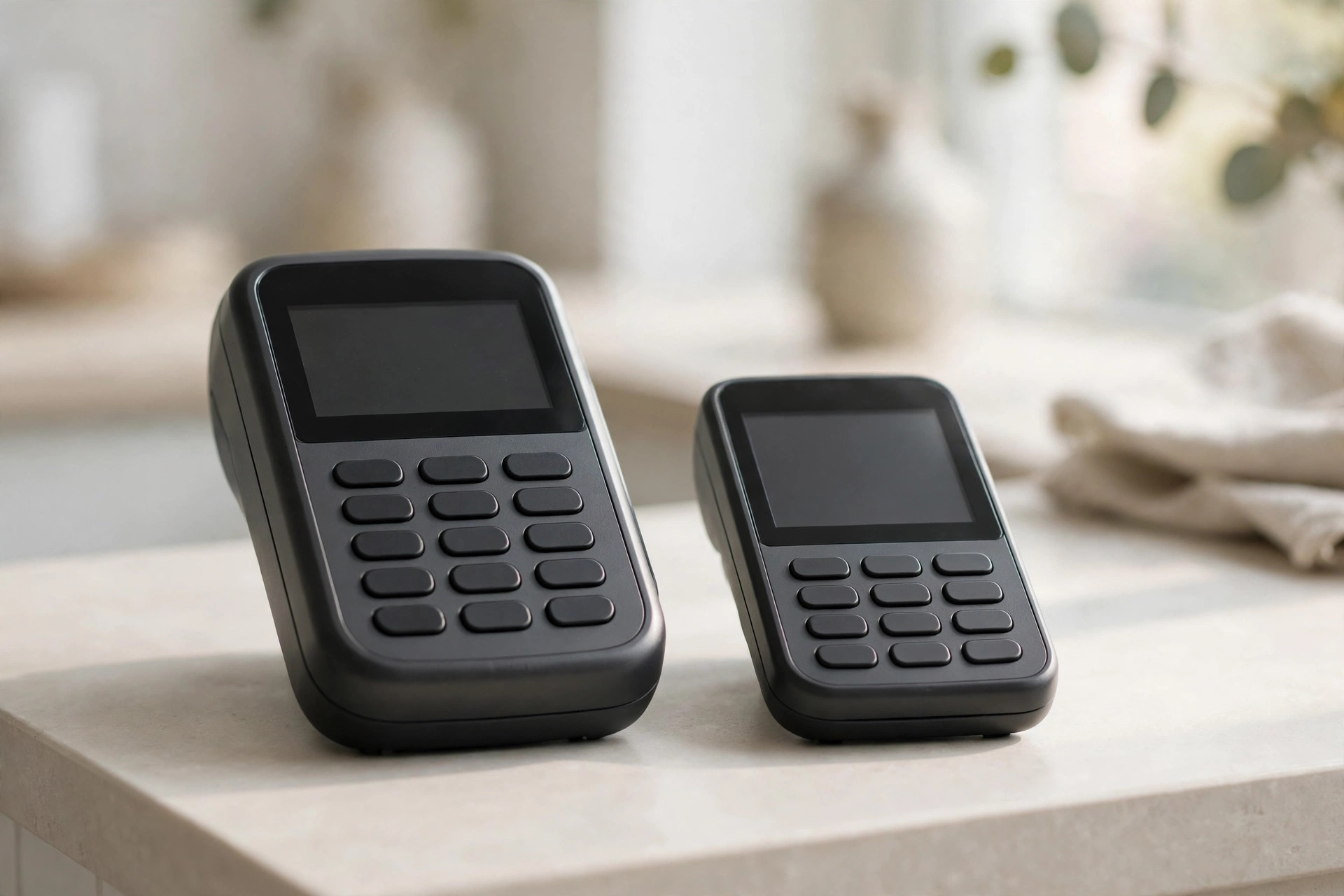
The buy-vs-lease debate usually ends at "$40 × 48 = $1,920." That's the headline, not the ledger. A fair comparison prices everything: the spare terminal you need when one dies, the repairs you own when you buy, the insurance you're forced to carry when you lease, and the buyout at the end. Trade note from across four processor change projects: the hardware conversation that mattered most was never the terminal price — it was who could replace a dead terminal fastest on a busy day.
The two options on the table
Buy: pay once (about $300 for a solid countertop terminal in our worked example), own it, choose your processor, and own the repairs. Lease: pay $40/month for 48 months, carry required equipment insurance, and return the device at the end. Terminals last several years with proper care — which is exactly why the lease math looks so bad.
Worked example: one terminal, four years
BUY ledger
Terminal purchase: $300. Spare on the shelf: $300. Repair/replacement budget over 4 years: $100. Total: $700. You own two working terminals at the end.
LEASE ledger
$40 × 48 months: $1,920. Equipment insurance (required, adds monthly for the full term). End of term: return the device, or face a buyout at an inflated price or continued month-to-month billing. Total: $1,920+ and you own nothing.
Delta: roughly $1,220+ in favor of buying — before insurance widens it further.
The buy ledger, line by line
| Line item | Cost | Notes |
|---|---|---|
| Terminal | $300 | Worked-example price; published readers run CA$69–CA$349 |
| Spare on the shelf | $300 | The cheapest uptime insurance you'll ever buy |
| Repairs / replacement | $100 budget | Your responsibility as owner; terminals last years with care |
| Processor freedom | $0 | Buy a portable (non-locked) terminal and switch processors without new hardware |
The spare deserves emphasis: a dead terminal on a busy Saturday with no backup costs more than the spare ever will. Buying outright plus a spare on the shelf is usually the cheapest uptime insurance available.
The lease ledger, line by line
| Line item | Cost | Notes |
|---|---|---|
| 48 monthly payments | $1,920 | Non-cancellable — returning the device early doesn't end the payments |
| Equipment insurance | Extra monthly | Required on most leases; amount varies |
| End of term | Buyout or continued billing | You return the device; cancel in writing or billing can continue |
| Processor freedom | $0 | The lease is usually with a separate company — switching processors doesn't touch it |
When leasing actually makes sense
Here is the honest pro-lease case, since the anti-lease content never makes it: a lease or maintenance agreement sometimes bundles the one thing buying can't — a service-level agreement with guaranteed replacement timing. For a merchant doing heavy weekend volume, one dead Saturday with no working terminal can cost more than a year of lease premiums. If the lease price is really buying you a 4-hour replacement guarantee in writing, price that against the $1,220 delta — and against the $300 spare on your own shelf. Most leases don't include a real SLA; the ones that do are maintenance agreements, not equipment leases, and should be priced as such.
The portability question
Whichever way you go, check whether the terminal is locked to one processor. Proprietary terminals (Clover is the classic example) only work with their own platform — you can't take them to a cheaper processor later. A portable, non-locked terminal preserves your freedom to switch, which is where the real long-term savings live. Ask "is this terminal portable?" before you ask about price.
FAQ
How long do card terminals last?
Several years with proper care — which is why a 48-month lease on a device with a multi-year useful life is such a bad trade.
Should I buy the cheapest reader instead of a terminal?
Published mobile readers run CA$69–CA$129 and suit mobile or backup use. For a fixed counter doing real volume, a proper terminal plus a spare is the sturdier setup.
What if I can't afford $300 upfront?
That cash-flow crunch is exactly what the lease exploits. Better answers: a cheaper published reader as a bridge, a used portable terminal, or a 0% credit card float for 30 days — all cheaper than $1,920 over four years.