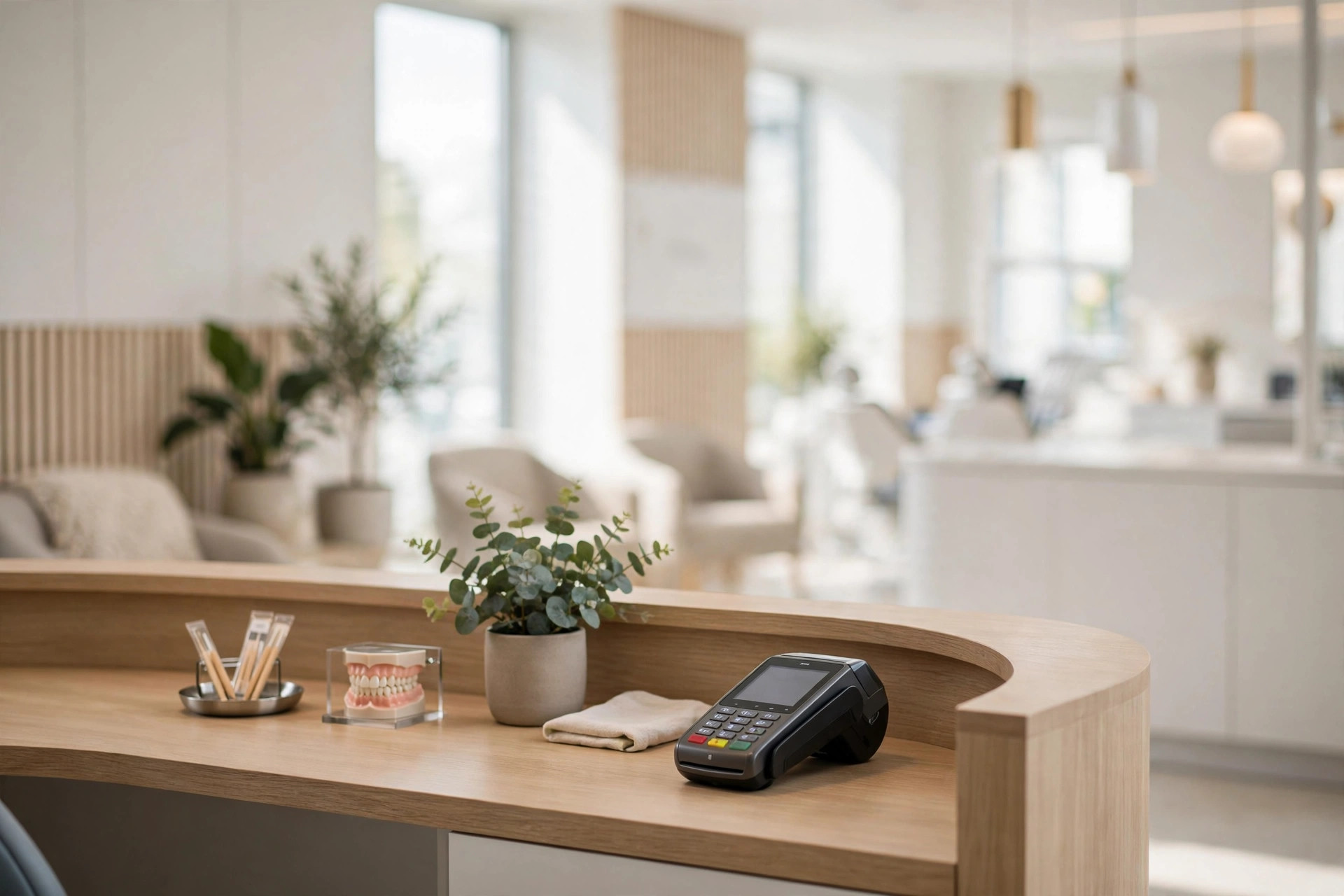
A dental clinic doesn't take payments like a store. The patient gets treatment, the insurance claim goes in, the insurer pays part, and the patient owes the rest — sometimes weeks later, sometimes by email link, sometimes split across two cards. That mix is exactly where processing fees hide: Canadian dental guides put Visa and Mastercard at roughly 1.4% to 2.9% and Interac debit at $0.05 to $0.25 per tap, but a clinic pays all three at once, on different terms.
Why dental payments cost differently: split billing, delayed payment, and the online surcharge
Three features of dental billing push fees above what a retailer pays on the same volume:
| Feature | What happens | Fee effect |
|---|---|---|
| Split billing | Insurer pays part, patient pays the balance — often on a different card, later | Two transactions (two per-transaction fees) instead of one |
| Payment links | Post-visit balances collected by email or SMS link | Card-not-present rates run higher than in-person — online interchange sits above chip/tap |
| Pre-authorizations | Holds placed for large procedures before treatment | Holds that settle late can downgrade to higher interchange if the data goes stale |
Canadian interchange spans roughly 0.92% to 2.4% depending on card type and channel, with total processing typically landing between 1% and 3%. The clinic's job is to keep as much of its volume as possible at the bottom of that band.
Worked math: a clinic at $60,000/month, worked three ways
The setup: $60,000/month in card volume. Mix: $30,000 card-present credit at the front desk (procedures), $18,000 via online payment links (card-not-present), $12,000 Interac debit for small balances. About 500 transactions total (~$120 average).
Flat-rate at 2.65% + $0.10/transaction: $60,000 × 2.65% = $1,590, plus 500 × $0.10 = $50. Total: ~$1,640/month (2.73% effective). Note what's happening: the $12,000 in debit is billed at 2.65% ($318) when the wholesale cost is about eight cents a tap.
Interchange-plus at wholesale + 0.40% + $0.10/transaction: wholesale on the mix runs near 1.50% (~$900), markup 0.40% (~$240), per-transaction ~$50, debit ~$12. Total: ~$1,202/month (2.00% effective).
Same, plus debit steering: small balances under $250 are steered to Interac at the front desk (debit share rises to $20,000). Total: ~$1,090/month — another ~$110/month saved, roughly $1,300 a year, from one front-desk habit.
The gap: flat-rate costs ~$550/month more than steered interchange-plus — about $6,600 a year. Assumptions are stated above; your mix moves the numbers, not the ranking.
Processor comparison with dated Canadian pricing
| Processor | Published Canadian pricing (checked) | Dental fit |
|---|---|---|
| Helcim | Interchange-plus, ~0.40% in-person margin over interchange (checked 2026-10-11) | Best for clinics over ~$25k/month; payment links and invoicing built in |
| Square | 2.50% in-person credit, Canada (checked 2026-10-11) | Simple for small clinics; online rate runs 2.80% + 30¢, which stings on payment-link volume |
| Moneris | Flat rate from 2.65% + $0.10 in-person; Interac $0.12/tap (checked 2026-10-11) | Bank-backed incumbent; interchange-plus option exists but is quote-based |
| Stripe | 2.90% + $0.30 domestic online, Canada (checked 2026-10-11) | Strong for payment links and custom billing flows; pricey as the primary in-person rail |
A note on the federal interchange cut: Visa and Mastercard agreed to reduce domestic consumer-credit interchange for eligible small businesses by up to 27% (weighted average 0.95% in-store) — worth confirming your processor actually passed it through, because not every statement shows it.
What clinics say: real merchant reviews
Merchant Maverick's Helcim review aggregates Trustpilot (~4.2–4.3/5 across 557–607 reviews) and G2 (~4.2/5): merchants praise the transparent interchange-plus pricing and responsive support, while complaints cluster on higher-than-expected effective rates at small volumes and occasional POS app instability (merchantmaverick.com/reviews/helcim-review). Moneris's Canadian Trustpilot reviews run polarized: praise for helpful support reps alongside merchants who discovered their effective rate was higher than expected after years — plus frustration with equipment restocking and cancellation fees (ca.trustpilot.com/review/moneris.com).
The debit-steering playbook for small balances
- Set the threshold. Balances under ~$250 default to Interac at the front desk; credit stays available on request. Interac costs cents per tap versus ~2% on credit.
- Script the ask. "We can run that on debit or credit — debit keeps your costs down too." One sentence, every small balance.
- Price the online channel honestly. Payment links bill at card-not-present rates; for large balances, a bank transfer or PAD option beside the link saves both sides.
- Audit the split bills. Every insurer/patient split is two transactions — confirm your per-transaction fee isn't eating the small half.
A note on steps: this is a fee-analysis guide, not a repair procedure — the numbered playbook above is the actionable part; there are no settings paths to click through.
FAQ
Should a dental clinic surcharge credit cards?
Canada permits surcharging within a 2.4% cap, with signage required at the entrance, checkout, receipt, and online — and it's barred in Quebec. For clinics, surcharging risks patient goodwill over small balances; debit steering usually recovers more with less friction.
What's the cheapest way to take a $200 balance?
Interac debit at roughly $0.05–$0.25 per transaction — about $0.08 typical — versus ~$4–$5 on credit at 2%+. For small balances, the payment method matters more than the processor.
Do pre-authorizations cost extra?
The hold itself doesn't, but a hold that settles late or with mismatched data can downgrade to a higher interchange tier. Settle pre-auths promptly with complete data.