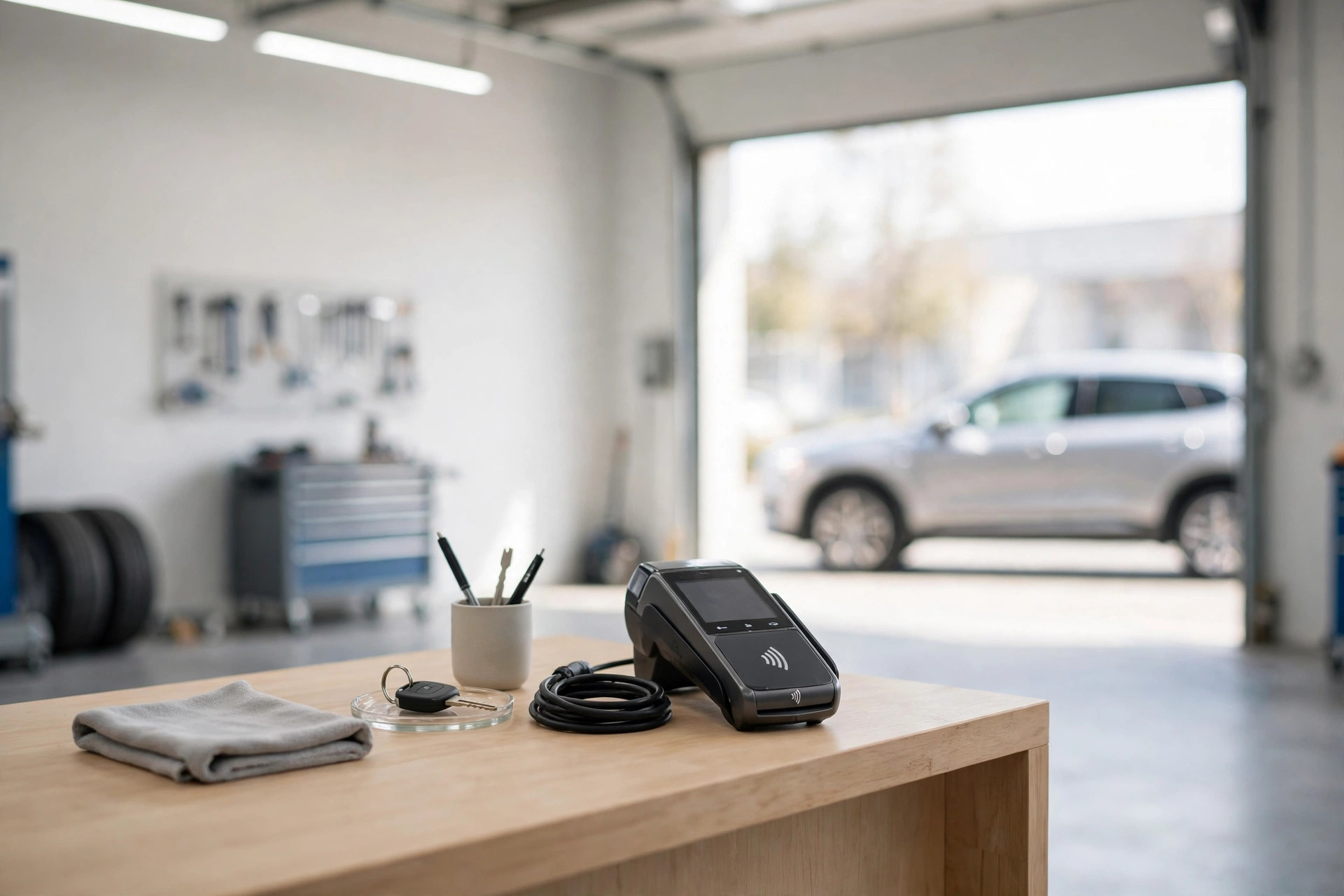
The average car repair invoice runs $500 to $600 — and four-figure totals are routine. At those ticket sizes, a percentage fee stops being a nuisance and becomes a line item: on a traditional processor at 3.5%, a $500 repair keeps just $482.50 after fees. Shops that still think of processing as "about three percent" are underestimating what it costs them per bay, per month.
Why the $600 ticket changes the math
On small tickets, the per-transaction fee (ten or thirty cents) is the enemy. On $600 tickets, it's irrelevant — the percentage is everything. That flips the usual advice: flat-rate simplicity costs a shop far more than it costs a coffee bar, because the gap between wholesale (~1.5% on a typical mix) and a 2.65% flat rate applies to every one of those six hundred dollars.
Worked math: a shop at $80,000/month, flat-rate vs interchange-plus
The setup: $80,000/month in card sales, $600 average ticket (~133 transactions). Card mix: 60% standard credit, 25% premium/rewards, 15% Interac debit.
Flat-rate at 2.65% + $0.10/transaction: $80,000 × 2.65% = $2,120, plus 133 × $0.10 = $13. Total: ~$2,133/month (2.67% effective).
Interchange-plus at wholesale + 0.40% + $0.10/transaction: wholesale on the mix runs near 1.50% (~$1,200), markup 0.40% (~$320), per-transaction ~$13. Total: ~$1,533/month (1.92% effective).
The gap: ~$600/month — about $7,200 a year — on identical sales. At shop ticket sizes, half a point of rate is a phone call worth making: the per-transaction fee barely registers, so the entire decision is the percentage.
Canadian surcharging: the rules, the cap, and the Quebec exception
Since the class-action settlement, Canadian merchants may surcharge credit cards — and auto shops are among the likeliest to consider it. A CFIB survey found about 19% of merchant members would offset fees by surcharging, with business-to-business sellers (jobber to shop) more inclined than consumer-facing ones. But the rules are specific:
- Cap: 2.4%. The surcharge may not exceed 2.4% of the transaction, and never more than your actual cost of acceptance.
- Notice: 30 days. Mastercard requires advance notice to both Mastercard and your acquirer at least 30 days before you start.
- Disclosure everywhere. Signage at the entrance, at the checkout, on the receipt — and online if you take web payments.
- Credit only. No surcharges on Interac debit or prepaid cards.
- Not in Quebec. Quebec's consumer-protection law blocks surcharging — shops there must use other levers.
One honest caveat from the trade press: many shops that already "build the fee into pricing" are effectively charging every customer — including debit and cash payers — the credit-card price. Surcharging, done by the book, is arguably fairer than that.
Processor comparison with dated Canadian pricing
| Processor | Published Canadian pricing (checked) | Shop fit |
|---|---|---|
| Helcim | Interchange-plus, ~0.40% in-person margin (checked 2026-10-11) | Best value above ~$25k/month; invoicing for fleet accounts built in |
| Chase (via Scotiabank) | 2.45% in-person credit published (checked 2026-10-11) | Bank-backed flat-ish option; keyed rate 2.75% for phone payments |
| Square | 2.50% in-person credit, Canada (checked 2026-10-11) | Simple counter setup; no monthly fee; costly at shop volumes |
| Moneris | Flat rate from 2.65% + $0.10 (checked 2026-10-11) | Incumbent with deep shop penetration; ask for interchange-plus by quote |
What shop owners say: real merchant reviews
Square's review picture is consistent across aggregators: users praise the ease of setup and use, while recurring complaints cite difficulty reaching live support, slowdowns at high transaction counts, and fees cutting into margins as volume grows (nasdaq.com/articles/square-review). On Capterra, Square POS holds strong ease-of-use scores (~4.7/5 from 3,000+ reviews), but individual negative reviews flag the tail risk of any aggregator — withheld funds and painful account-resolution processes (capterra.co.nz/software/154907/square-point-of-sale). Moneris's Canadian Trustpilot reviews are polarized: helpful support reps on one side, merchants discovering higher-than-expected effective rates and equipment restocking fees on the other (ca.trustpilot.com/review/moneris.com).
The phone-payment and after-hours problem
Shops take cards over the phone for authorizations and after-hours pickups — and keyed-in rates run higher (Square Canada: 3.30% + 15¢ manually entered; Chase: 2.75% keyed). If a meaningful share of your volume is keyed, that line deserves its own comparison: a payment link or terminal-based tap usually beats keying the number in.
A note on steps: this is a fee-analysis guide with a rules checklist, not a repair procedure — the numbered surcharge rules above are the actionable part.
FAQ
Can my shop surcharge in Quebec?
No. Quebec's consumer-protection law prohibits credit-card surcharges. Quebec shops should lean on debit steering and interchange-plus pricing instead.
What's the maximum surcharge in Canada?
2.4% of the transaction, capped at your actual cost of acceptance — with 30 days' notice to the card brand and your acquirer, and signage at the entrance, checkout, receipt, and online.
At what volume does interchange-plus beat flat-rate for a shop?
With $600 tickets the crossover comes early — often around $20,000–$25,000/month — because the per-transaction fee is negligible and the percentage gap applies to big tickets.