Helcim is the Canadian processor that publishes its markup instead of quoting it. That's the whole pitch: interchange-plus pricing, no monthly account fee, no cancellation fee, hardware you buy outright. The question isn't whether the model is transparent — it's whether the math beats flat-rate at your volume and card mix. Here's the model, worked.
The published model: what interchange-plus means
Interchange-plus means two separate numbers on every transaction: the card networks' interchange (passed through at cost — Helcim doesn't mark it up) plus Helcim's own margin. Published margins: in-person interchange + 0.40% + 8¢; keyed and online interchange + 0.50% + 25¢; ACH/bank payments 0.5% + 25¢ (capped at $6 per transaction under $25,000). There is no monthly account fee, no setup fee, and no cancellation fee. The margin drops automatically as your monthly volume grows, priced off a rolling three-month average. Chargebacks cost $15 — $0 if you win the dispute.
Bundled at no extra charge: the virtual terminal (for phone orders), invoicing software, recurring billing, a hosted payment page, and basic POS software. Many processors charge $25–$50/month for these separately. Helcim also offers an optional surcharge program ("Fee Saver") for eligible businesses, subject to the card networks' surcharge rules.
Worked: the effective rate on a realistic Canadian mix
Worked example — $20,000/month, 800 sales ($25 average ticket), 1.6% average interchange:
Interchange at cost: $320. Helcim margin: 0.40% ($80) + 800 × $0.08 ($64) = $144. Total: $464/month — a 2.32% effective rate, with no monthly fee. Against a flat 2.6% ($520/month), that's $56/month or $672/year saved. An independent Canadian review working the same volume estimates roughly $170/month in savings once volume discounts compress the margin — the gap widens as you grow, because the margin shrinks automatically and the flat rate never does.
The key insight: your effective rate floats with your card mix. A month heavy on basic cards lands near 2.1%; a month heavy on premium rewards cards pushes toward 2.6%+. That's the trade for transparency — the bill is honest, but it's not fixed. If your card mix skews premium, model it at 2.0%+ average interchange before deciding.
Hardware: buy it once, own it
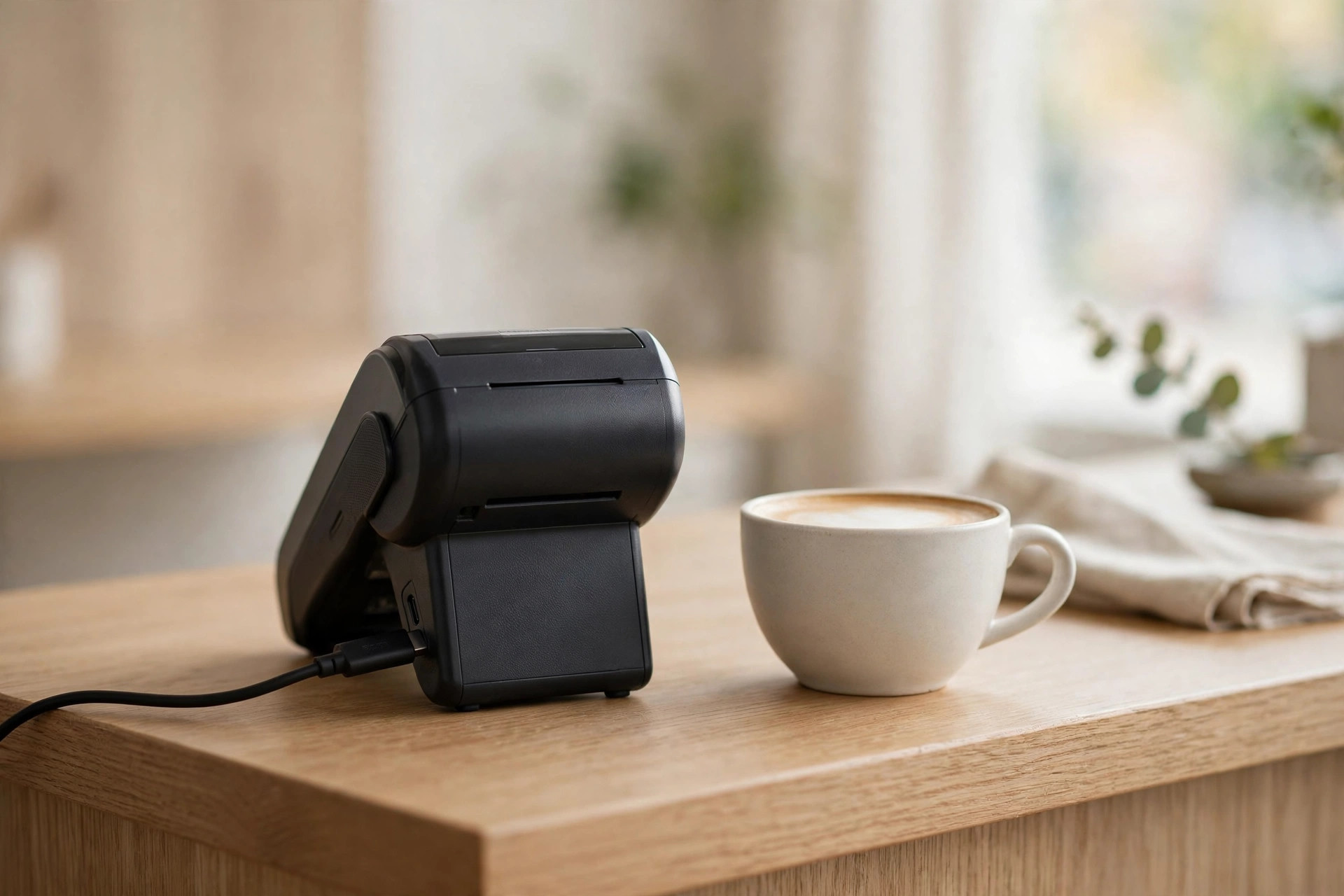
The Smart Terminal costs $329 CAD — a standalone POS device with built-in printer, touchscreen, and WiFi/LTE, with no monthly fee attached. The card reader (for phones/tablets) is $129. You buy once and own it outright, with no ongoing hardware line item on the monthly bill. Compare that against the industry's favorite trap: leased terminals that cost three to four times the purchase price over the contract and never become yours. Helcim's model also means no PCI, statement, or batch fees — the line items that pad traditional processor statements simply don't exist here.
Helcim vs flat-rate, side by side
| Helcim | Square (flat-rate) | |
|---|---|---|
| Pricing model | Interchange + 0.40% + 8¢ in person | Flat 2.6% in person |
| Monthly fee | $0 | $0 (base tier) |
| Effective rate at $20k/mo | ~2.32% (floats with card mix) | 2.6% (fixed) |
| Hardware | $329 terminal / $129 reader, owned | Reader from $0–$59; paid terminals/registers |
| Volume discounts | Automatic, rolling 3-month average | Tiered plans ($49/$149/mo) lower the rate |
| Contract | Month-to-month, no cancellation fee | Month-to-month |
Honest fit: who wins and who loses
Helcim wins for: mid-volume in-person businesses ($10k+/month) where the margin discount beats flat-rate; B2B and wholesalers with large average tickets, where interchange-plus structurally outperforms flat percentages; seasonal businesses — no monthly fee means slow months cost nearly nothing; and merchants who want itemized statements they can actually audit.
Helcim loses for: very low-volume or micro-ticket businesses — the per-transaction fees (8¢/25¢) bite when tickets are tiny, and a flat-rate reader with a free device is cheaper to start; debit-heavy counters where a pure Interac routing play costs less; and merchants who want a deep POS ecosystem (Helcim's POS software is free but basic next to Toast or Lightspeed). Approval takes 1–3 days, and the account terms permit holds and reserves — standard, but worth knowing.
The pattern from several processor migrations holds: the cheapest quote is rarely the cheapest year. Helcim's advantage isn't a teaser rate — it's that every number is published, the margin only moves in your favor with volume, and there's no contract to escape if the math stops working.
A note on format: this is an explainer, not a procedure — there are no step-by-step actions because the question it answers is which setup fits your business, and that is what the comparisons above are for.
FAQ
Does Helcim really have no monthly fee?
Correct — no monthly account fee, no setup fee, no cancellation fee, and no PCI, statement, or batch fees. You pay the per-transaction margin plus interchange. Optional services (some recurring-billing configurations) can carry extra fees, and hardware is a separate one-time purchase.
Is Helcim good for a small business?
For small-to-mid businesses processing five figures a month in person, yes — the effective rate typically lands well under flat-rate. For micro businesses with tiny tickets or very low volume, the per-transaction fees and paid hardware make a free flat-rate reader cheaper to start.
What hardware does Helcim offer in Canada?
The Smart Terminal ($329 CAD, standalone with printer and touchscreen, no monthly fee) and a $129 card reader for mobile devices. Both support tap, chip, and swipe, plus Apple Pay and Google Pay. You own the hardware outright.