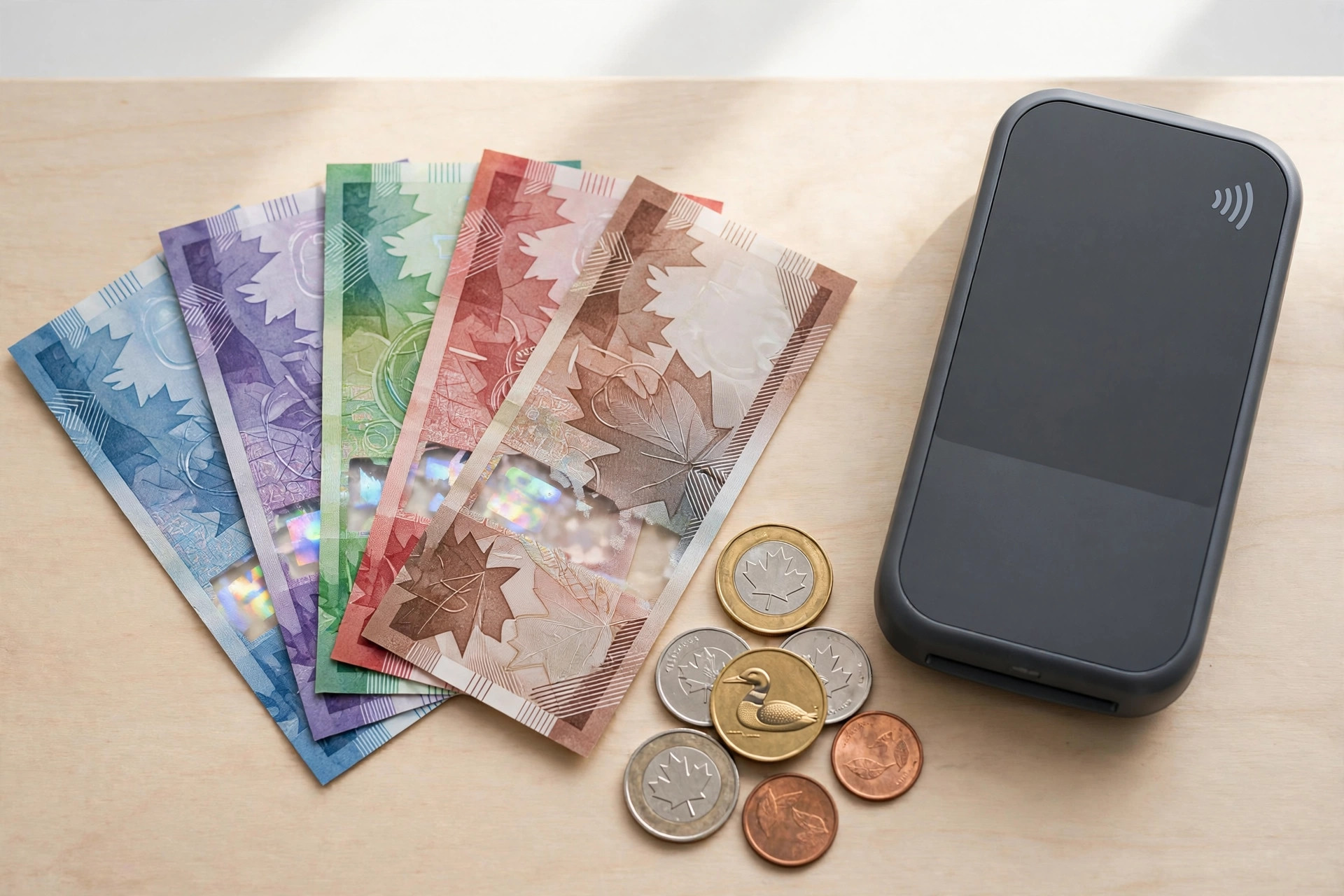
Canadian merchants looking to offset card-acceptance costs face two doors: add a surcharge to credit card payments, or offer a discount for cash. Under Canada's Code of Conduct for the Payment Card Industry, merchants may choose to offer discounts for different payment methods and between different card networks — but surcharges come with disclosure duties and card-brand rules that discounts don't. Get the framing wrong and a "discount" can be treated as a disguised surcharge.
What a cash discount program actually is
In a compliant cash discounting program, the posted price is the cash price. Customers paying with cash pay exactly what they see on the shelf or menu. Customers paying by card pay a higher credit price that reflects the cost of card acceptance. Modern POS systems automate this: the register applies the adjustment to card transactions and discounts it back for cash payments. The key legal distinction: a surcharge is a fee added at checkout to card transactions; a cash discount is a pricing model — the price structure is established before the transaction begins.
Cash discount vs surcharge vs dual pricing
| Cash discounting | Surcharging | Dual pricing | |
|---|---|---|---|
| Applies to | Non-cash payments | Credit cards only | Card price vs cash price |
| Debit cards | Allowed | Not allowed (network rules) | Allowed |
| Card-brand notification | Not required | Required | Not required |
| Compliance burden | Moderate | High | Lower |
| Customer framing | "Discount" | "Fee" | Two prices upfront |
Dual pricing is often confused with cash discounting — and many POS providers market their programs as "cash discounting" when what they actually deploy is dual pricing: two prices displayed upfront (a cash price and a card price), with the customer choosing before payment. No discount or surcharge line item is added; the difference is already built in. The distinction matters because compliance rules depend on how and when the price difference is shown.
What Canadian rules actually say
The federal Code of Conduct is explicit: merchants may offer discounts for different payment methods. On surcharges, the card networks' own rules apply — and in Canada those rules were shaped by a class-action settlement under which Visa and Mastercard agreed to permit credit card surcharges up to 2.4%, subject to applicable provincial and federal laws. Surcharge rules also require disclosure at the point of entry into the business and at the point of transaction. For debit, some networks don't allow surcharging at all — verify with your payment processor before assuming.
The receipt math: a worked $100 example
Cash discount model (3%): posted price $100.00. Cash customer: subtotal $100.00, cash discount −$3.00, total $97.00. Card customer: total $100.00.
Surcharge model (2.4%, the Canadian cap): cash or debit customer: $100.00. Credit card customer: subtotal $100.00, credit card surcharge +$2.40, total $102.40.
The card-paying customer ends up in a similar place either way — but the receipt, the disclosure duties, and the customer psychology are completely different. A discount reads as a small gain; a surcharge reads as a penalty.
Compliance checklist before you launch
- Confirm with your processor. Ask whether your merchant account supports cash-discount or dual pricing, which card types it covers, and whether debit is included. Get the answer in writing.
- Set the posted price as the cash price. In your POS payment settings, configure the cash price as the displayed price and program the card-price adjustment — never the reverse.
- Make the receipt tell the story. Cash receipts should show the discount as a line item (Subtotal $100.00 / Cash discount −$3.00 / Total $97.00). Card receipts should show the credit price clearly.
- Disclose before payment. Post the policy at the entrance and at the till. Surcharges and fees must be disclosed before the transaction is completed, and customers must be able to cancel without penalty and pay another way.
- Train the one-line script. Staff should say "cash price" and "card price" — never "fee," "surcharge," or "extra charge."
- Audit the first week. Pull a week's receipts and check: cash customers paid the posted price, card receipts show the adjustment, and signage is visible at entry and till.
What success looks like: a mystery shopper can see both prices before paying, every receipt shows the math as a line item, and no customer is surprised at the till. If any of those fail, pause and fix the setup before the next business day.
Legal note: this guide is general information about Canadian payment rules, not legal advice. Payment-card rules and provincial laws change — confirm your program with your payment processor and qualified counsel before launch.
FAQ
Is cash discounting legal in Canada?
The Code of Conduct for the Payment Card Industry in Canada expressly allows merchants to offer discounts for different payment methods. Surcharging is separately permitted by the card networks up to 2.4%, with disclosure rules. The two are treated differently — don't assume what applies to one applies to the other.
Can I apply the discount to debit card payments too?
Yes — unlike surcharging, cash discounting can cover debit. But check with your processor: some networks restrict what merchants can do with debit, and your agreement governs.
What's the difference between cash discounting and dual pricing?
Cash discounting applies a discount line item at checkout against a posted cash price. Dual pricing displays both prices upfront and charges the corresponding one — no line item added. Many POS "cash discount" programs are technically dual pricing.